
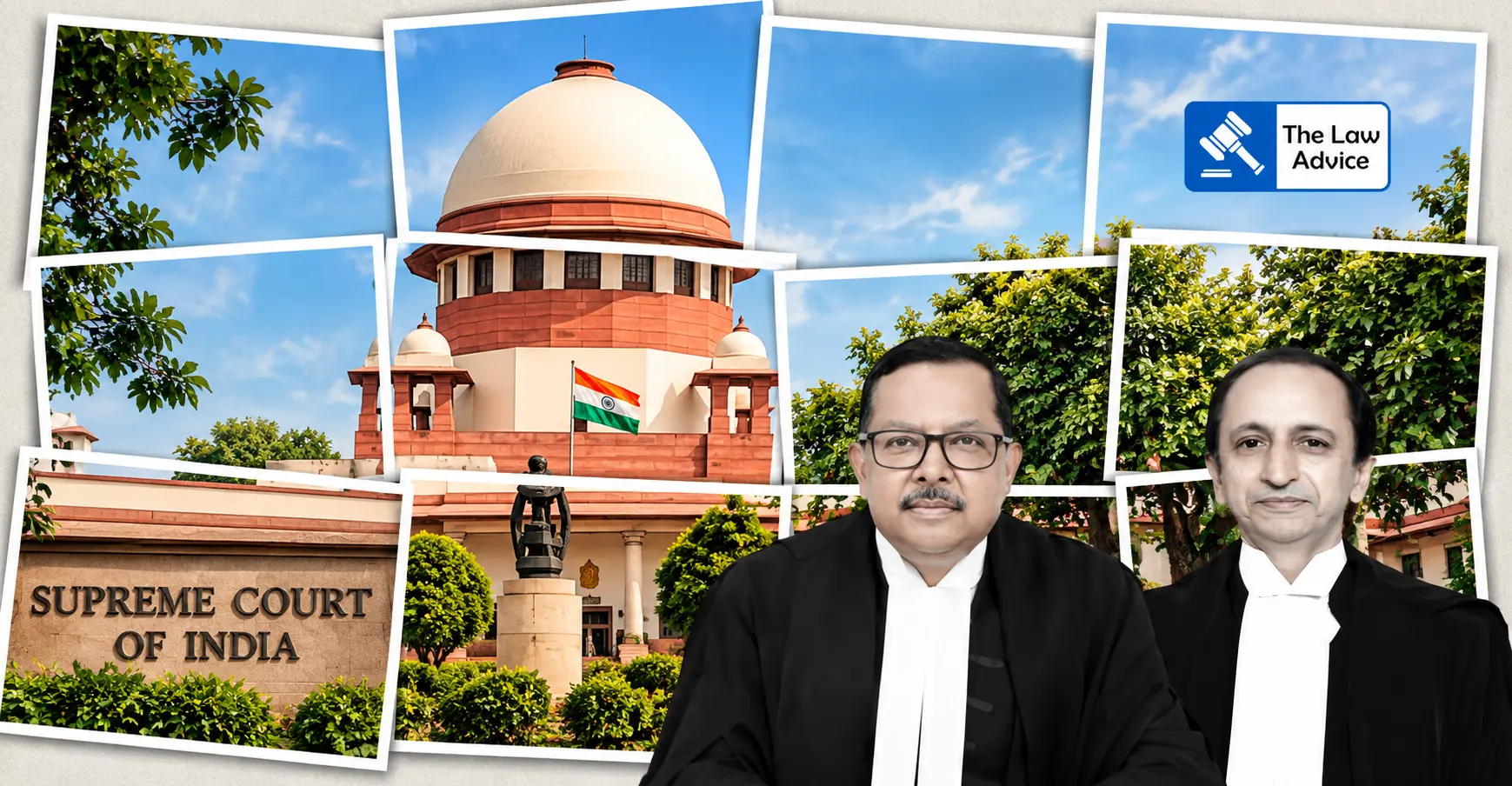
The Supreme Court has held that a motor accident compensation claim under Section 166 of the Motor Vehicles Act, 1988 cannot be filed before a Claims Tribunal merely because the insurer has an office or carries on business within that Tribunal’s territorial jurisdiction.
A Bench comprising Justice Ujjal Bhuyan and Justice Atul S. Chandurkar upheld the transfer of a motor accident compensation claim from the Motor Accidents Claims Tribunal at Chennai to the Tribunal at Chittoor, Andhra Pradesh.
The case arose from an accident on October 25, 2022, when the appellant, K. Rashik, was riding a two-wheeler with his brother in Tirupati District, Andhra Pradesh. A mini truck allegedly collided with their vehicle.
Rashik subsequently filed a compensation claim under Section 166 of the Motor Vehicles Act before the Motor Accidents Claims Tribunal at Chennai.
The insurer, National Insurance Company Limited, objected to the territorial jurisdiction of the Chennai Tribunal, contending that no part of the cause of action had arisen within Chennai.
The Chennai Tribunal rejected the objection, primarily because the insurer carried on business in Chennai. However, the Madras High Court subsequently held that the Tribunal at Chittoor had jurisdiction since the accident had occurred there and transferred the proceedings to Chittoor.
The Supreme Court examined Section 166(2) of the Motor Vehicles Act, which provides different options for filing a compensation claim.
The Court held that a claimant can file the application before the Tribunal having jurisdiction over:
the area where the accident occurred;
the area where the claimant resides;
the area where the claimant carries on business; or
the area within which the defendant resides.
The Court specifically noted that while the provision uses the words “resides or carries on business” in relation to the claimant, it uses only “the defendant resides” in relation to the defendant.
The Court held that the expression “defendant” in Section 166(2) does not include an insurer merely because the insurer has an office or carries on business at a particular place.
The Court pointed out that impleading an insurer as a defendant in a motor accident claim is not mandatory. The insurer ordinarily receives notice of the proceedings, and therefore the legislative scheme does not treat the place where the insurer carries on business as an independent basis for territorial jurisdiction under Section 166(2).
The judgment also distinguished Section 166(2) from Section 20 of the Code of Civil Procedure, under which a civil suit can ordinarily be instituted where the defendant carries on business. The Court noted that such wording is deliberately absent from Section 166(2).
The Court further held that when a claimant voluntarily impleads the insurer as a party-respondent, the insurer is entitled to raise all legally permissible grounds, including an objection to territorial jurisdiction.
Relying on the three-Judge Bench decision in United India Insurance Co. Ltd. v. Shila Datta, the Court reiterated that an insurer impleaded as a party-respondent is not restricted only to the limited grounds available under Section 149(2) of the Motor Vehicles Act.
The Supreme Court also clarified the distinction between an objection raised at the initial stage of the claim and one raised at the appellate stage.
Where the objection is raised before the Tribunal at the initial stage, the requirements of Section 166(2) govern the question of territorial jurisdiction.
However, where the objection is raised at the appellate stage after an award, Section 21(1) of the CPC becomes relevant, requiring the party raising the objection to demonstrate that the proceedings in the wrong territorial jurisdiction resulted in a failure of justice.
The Court referred to earlier decisions including Mantoo Sarkar v. Oriental Insurance Co. Ltd., Malati Sardar v. National Insurance Co. Ltd. and Balveer Batra v. The New India Assurance Co., explaining that those cases involved territorial-jurisdiction objections raised at the appellate stage.
In the present case, the Supreme Court noted that Rashik's claim petition itself showed his residence in Chittoor District, Andhra Pradesh, while the accident occurred in Tirupati District. There was no pleading that he carried on business within Chennai.
The driver of the offending vehicle was also stated to reside in Chittoor District.
Consequently, the Court concluded that no part of the cause of action arose within Chennai so as to confer territorial jurisdiction on the Chennai Tribunal.
The Court acknowledged that the Motor Vehicles Act is beneficial legislation intended to address hardships arising from motor accidents. However, it held that such purposive interpretation cannot override the plain language of the statute.
The Supreme Court therefore upheld the Madras High Court's order transferring the proceedings from Chennai to Chittoor and directed that the claim be adjudicated expeditiously by the Chittoor Tribunal.
The appeal was accordingly dismissed.
Case: K. Rashik v. National Insurance Company Ltd. & Anr.
Citation: 2026 INSC 996
Civil Appeal: No. 10706 of 2026
Bench: Justice Ujjal Bhuyan and Justice Atul S. Chandurkar
Date: September 16, 2026.

Representation:-
For Petitioner(s):- Mr. A. Sirajudeen, Sr. Adv. Mr. C.R.Jaya Sukin, Adv. Ms. Yashika Anand, Adv. Ms. Seerat Nissar Bhat, Adv. Mr. Abhishek Tyagi, Adv. Mr. Praveen Kumar L., Adv. Ms. Laveena Tak, Adv. Mr. M. Dhandapani, Adv. Mr. Roshan Chapagain, Adv. Mr. Narender Kumar Verma, AOR
For Respondent(s):- Mr. Sanathana Bhaarath, AOR Mr. S.L. Gupta, Adv.
Website designed, developed and maintained by webexy