
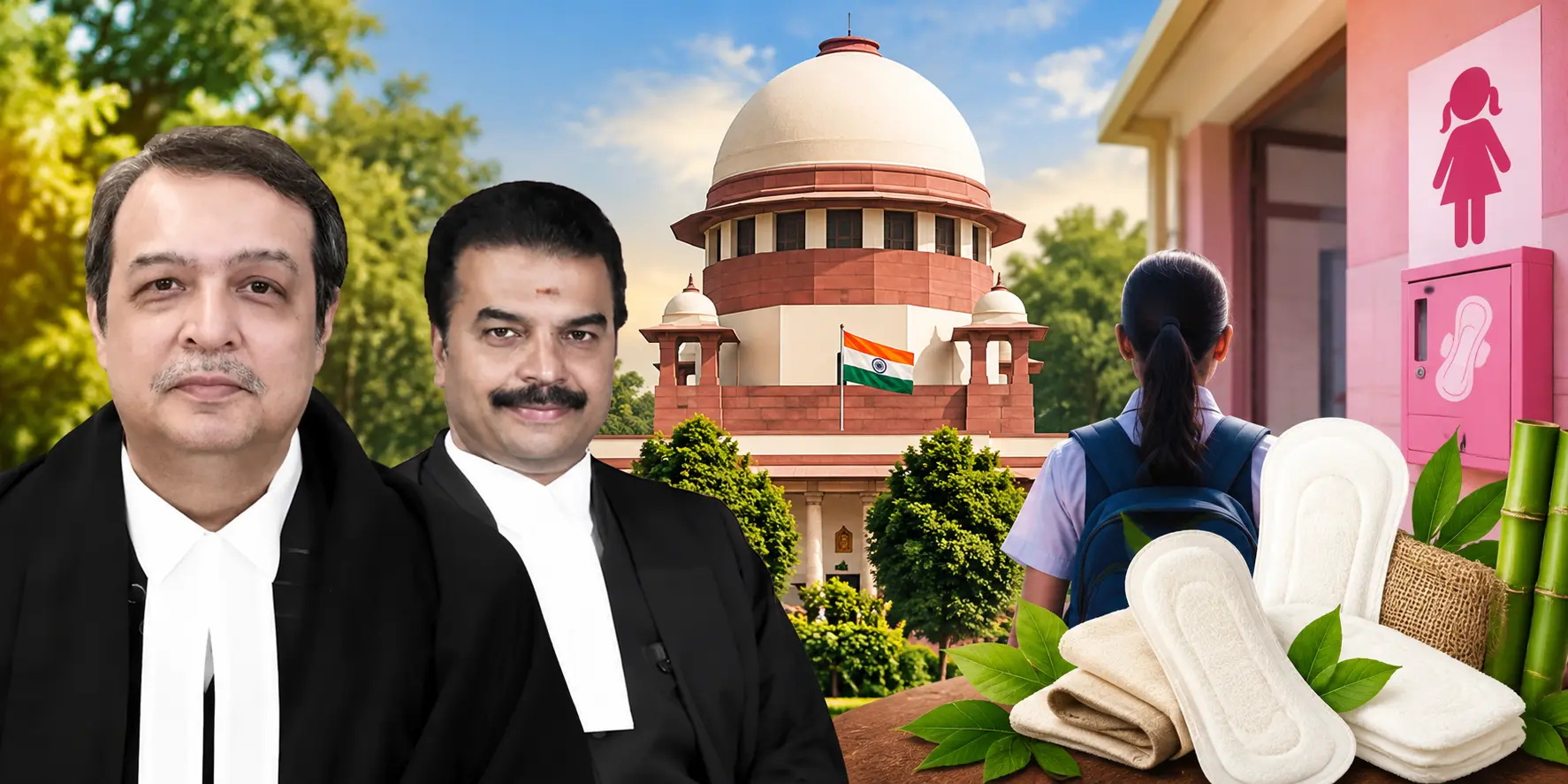
The Supreme Court has modified its earlier directions on menstrual hygiene in schools, directing States and Union Territories to move towards the use of biodegradable, biocompatible and compostable sanitary napkins instead of oxo-biodegradable sanitary napkins.
A Bench comprising Justice J.B. Pardiwala and Justice R. Mahadevan passed the directions while monitoring compliance with its earlier judgment in Jaya Thakur v. Government of India & Ors.
In its earlier judgment dated January 30, 2026, the Court had directed every Government and privately managed school in urban and rural areas to provide oxo-biodegradable sanitary napkins manufactured in compliance with ASTM D-6954 standards free of cost to girl students.
During the present proceedings, however, the Indian Compostable Polymer Association brought to the Court's attention concerns regarding the environmental impact of oxo-biodegradable sanitary napkins.
The Court was informed that such products may break down into microplastics and nanoplastics when disposed of through landfills, burial, composting, pit burning or incineration.
The Court noted the distinction between compostable, biodegradable and oxo-biodegradable materials. It observed that oxo-biodegradable materials are made from fossil-based plastics containing additives and, under conditions where exposure to ultraviolet radiation, oxygen and suitable temperatures is absent, may behave similarly to conventional plastics and break down into micro- or nanoplastic fragments.
The Supreme Court emphasised the use of biodegradable and compostable sanitary napkins, noting that products made from materials such as bamboo, jute, banana, starch and corn could provide a more sustainable solution to menstrual waste.
The Court observed that biodegradable and compostable napkins can naturally decompose when disposed of through appropriate burial pits, whereas oxo-biodegradable materials primarily accelerate the breakdown of visible plastic into smaller particles.
Accordingly, the Court modified its earlier direction. The expression “oxo-biodegradable sanitary napkins manufactured in compliance with ASTM D-6954 standards” will now be read as “biodegradable, biocompatible and compostable sanitary napkins in compliance with ISO 17088 read with IS 5405 standards.”
The Court clarified that the responsibility for ensuring that such sanitary napkins are safe and effective for use will lie with the respective State and Union Territory Governments.
The Court further directed States and UTs to gradually move towards more eco-friendly and scientifically validated menstrual absorbents, including biodegradable sanitary napkins, cloth-based or reusable sanitary napkins, menstrual cups and period panties.
It suggested that States may initially promote reusable sanitary napkins by educating girl students about their proper use and the precautions required.
While acknowledging progress in implementing its earlier directions, the Court expressed dissatisfaction with the manner in which several States and UTs had reported compliance.
The Court noted that some responses appeared to consist merely of statistics or “yes/no” answers, without adequately demonstrating whether the directions were actually being implemented on the ground.
The Union's affidavit stated that out of 39,439 girls' toilets identified as non-functional or requiring completion, 30,458 had been constructed, 4,236 were under construction and 4,745 remained as a gap.
The affidavit also reported that many States and UTs were providing sanitary pads to girls in Classes VI to XII through various government programmes, while vending machines and Menstrual Hygiene Management (MHM) corners were also being established in schools.
The Supreme Court directed that, for the next compliance cycle, District Education Officers (DEOs) shall form teams of teachers to conduct surprise inspections of schools within their respective jurisdictions.
The inspections will assess compliance with the Court's directions relating to toilets, washing facilities and menstrual hygiene infrastructure.
The Court also directed that future compliance reports should focus on the remaining gaps, rather than merely listing achievements. States and UTs must identify schools lacking functional gender-segregated toilets, usable water connectivity, accessibility and privacy, along with the reasons for the gaps and the time required to address them.
The matter has been directed to be listed again on September 29, 2026.
Case: Jaya Thakur v. Government of India & Ors.
Citation: 2026 INSC 994
Bench: Justice J.B. Pardiwala and Justice R. Mahadevan
Order: September 1, 2026.

Website designed, developed and maintained by webexy