
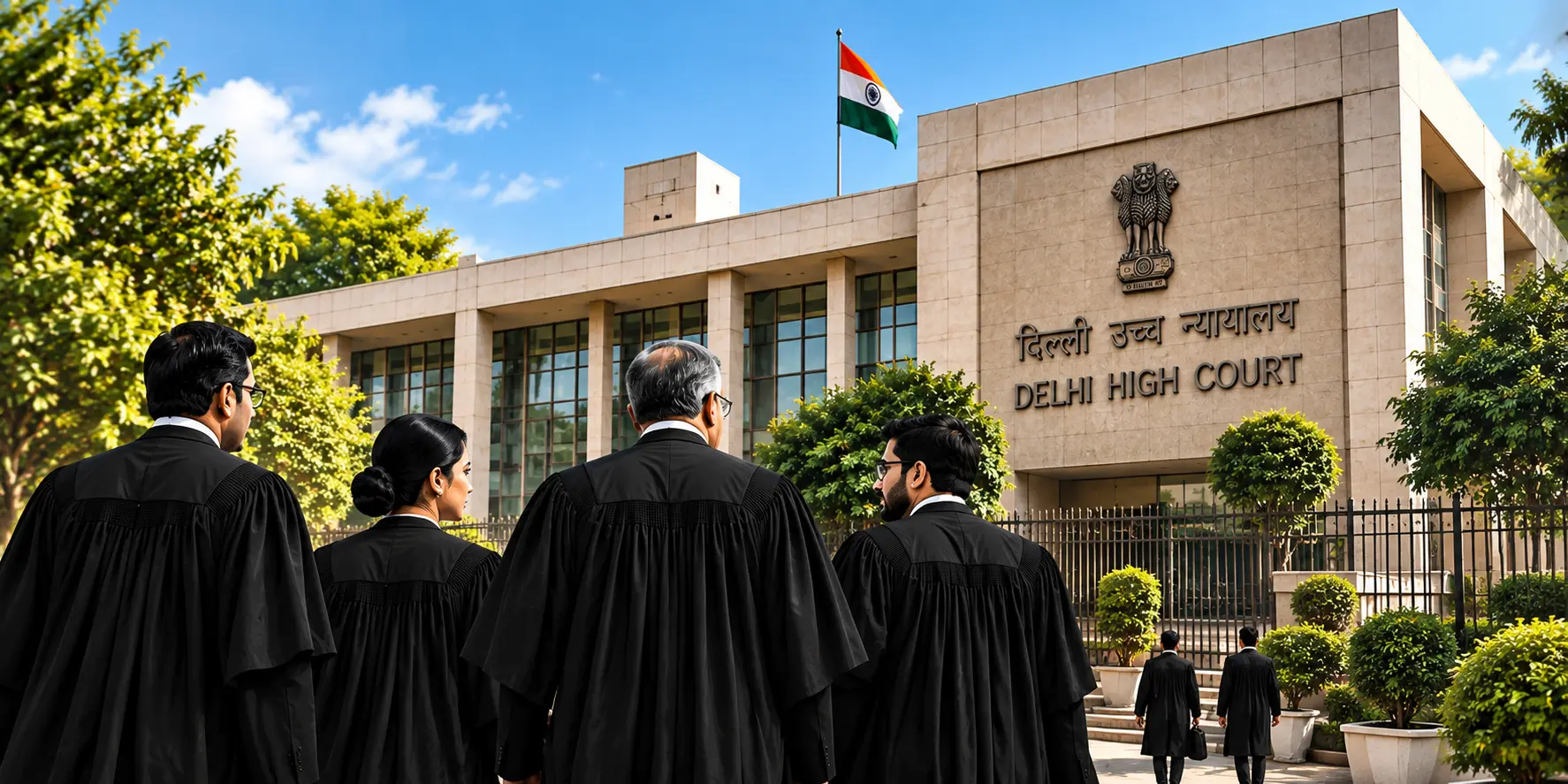
The Delhi High Court has notified a new set of rules governing the designation of advocates as Senior Advocates, replacing the framework notified in March 2024.
Under the new rules, factors such as an advocate's fairness, courtroom conduct, professional ethics, mentoring of junior advocates, pro bono work and standing in the legal fraternity will be considered while deciding whether the designation should be conferred.
A significant change under the new framework is the abolition of the committee for designation of Senior Advocates that existed under the earlier rules.
The designation process will now be overseen by a Permanent Secretariat headed by an officer of the rank of Registrar, while the final decision will be taken directly by the Full Court of the Delhi High Court.
The process will ordinarily be initiated at least once every year by inviting applications. Notice of the process will be published on the High Court's website and communicated to the Delhi High Court Bar Association (DHCBA). Applicants will be provided at least 21 days to submit their applications.
Under the new rules, an advocate should ordinarily:
The minimum practice requirement will not apply to former officers of the Delhi Higher Judicial Service (DHJS) who have less than 10 years of cumulative experience as judicial officers and/or at the Bar.
Once applications are received, the Permanent Secretariat will publish the names of the applicants on the High Court's website and invite suggestions and views from stakeholders.
Such views can be submitted within four weeks. In cases involving advocates practising before specialised tribunals, trial courts or district courts, views may also be sought from tribunal chairpersons and Principal District and Sessions Judges.
After collecting the relevant information, the Permanent Secretariat will place the applications of eligible candidates, along with supporting documents, before the Full Court with the approval of the Chief Justice.
The Full Court may consider several qualitative factors while deciding whether to designate an advocate as a Senior Advocate.
These include the advocate's:
The rules also state that the Full Court is not required to record reasons for its decision.
The Full Court will endeavour to decide the designation process by consensus.
Where consensus cannot be reached, voting may be undertaken. In such a situation, the decision will require a two-thirds majority of the judges who have voted.
The Full Court may also decide whether the voting should be conducted through a secret ballot.
The new rules expressly provide that canvassing by a nominee for designation as a Senior Advocate will result in disqualification from designation.
The process may be initiated either suo motu by the Full Court or through an application submitted by an eligible advocate.
An advocate whose application is rejected will remain ineligible for consideration for a period of two years. After that period, the advocate may seek review or reconsideration in accordance with the prescribed procedure.
The Full Court will also have the power to recall the designation of a Senior Advocate, provided the concerned advocate is given an opportunity of hearing.
The new rules thus introduce a Full Court-based designation mechanism while expressly making professional conduct, ethics, mentoring, pro bono contribution and standing within the legal profession relevant to the consideration of Senior Advocate designation.
Website designed, developed and maintained by webexy