
The Supreme Court has clarified the circumstances in which a civil court can take up an issue as a preliminary issue under Order XIV Rule 2 of the Code of Civil Procedure, 1908 (CPC). The Court held that once a trial on the issues framed in a suit has already commenced, a court cannot subsequently segregate one issue and direct that it be tried first.
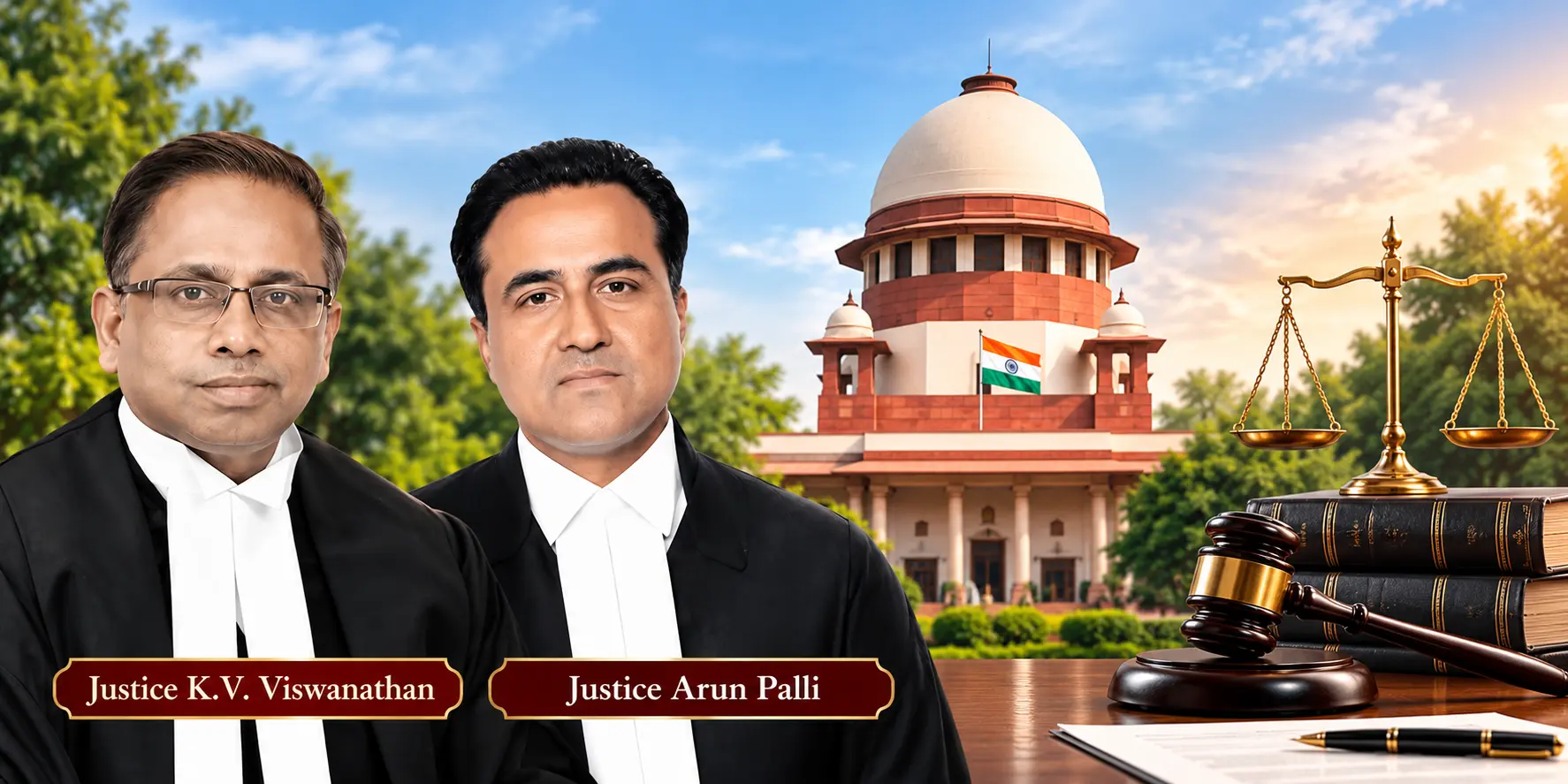
The judgment was delivered in Civil Appeal arising out of SLP (C) No. 34086 of 2025, John Mathew v. Santha Paul & Ors., by a Bench comprising Justice K.V. Viswanathan and Justice Arun Palli.
The dispute arose from a suit filed in 2013 concerning a sale deed executed in 2005. The plaintiff had executed a General Power of Attorney (GPA) in favour of Defendant No. 1 for management of agricultural land. The plaintiff alleged that the subsequent sale of the property was beyond the authority granted under the GPA and was therefore void.
The plaintiff claimed that he came to know about the sale deed on 22 May 2009, while the suit was instituted on 10 June 2013. The defendants contended that the suit was barred by limitation under Article 59 of the Limitation Act, which provides a three-year limitation period for cancellation of an instrument.
The Trial Court had framed issues in July 2015, including an issue specifically concerning limitation. After the trial had substantially progressed, Defendant No. 2 filed an application in 2018 seeking determination of the limitation issue as a preliminary issue. The Trial Court accepted the plea and dismissed the suit as barred by limitation.
The First Appellate Court affirmed the decision, while modifying the disposal of the case as a rejection of plaint under Order VII Rule 11(d) CPC. The Kerala High Court subsequently held that the limitation issue involved mixed questions of fact and law and that the suit could not have been terminated at the preliminary stage. It restored the suit for fresh consideration on merits.
The Supreme Court undertook a detailed examination of the legislative history and scheme of Order XIV Rule 2 CPC.
The Court noted that after the 1976 amendment, the general rule is that a court should pronounce judgment on all issues. However, an exception remains where an issue of law relates to either the jurisdiction of the court or a bar to the suit created by law and the case or a part of it can be disposed of on that issue alone.
The Court stressed that the issue must be an “issue of law only.” A mixed question of law and fact cannot ordinarily be tried as a preliminary issue where its determination requires adjudication of disputed facts.
At the same time, the Court clarified that the mere fact that all issues have already been framed does not, by itself, prevent a court from exercising the power under Order XIV Rule 2(2). What is decisive is whether the court has already embarked upon the trial of the issues generally.
The Supreme Court explained that the expression “try that issue first” contemplates a prospective ordering of the trial.
Once evidence has begun on the issues generally, a court cannot retrospectively rearrange the proceedings and treat one issue as though it had to be tried first.
The Court observed that “first” is relational and concerns the sequence of trial. Once issues have entered a common trial, the court cannot retrospectively reorder that trial by separating one issue for prior adjudication.
The Court also clarified that the power under Order XIV Rule 2(2) is not lost merely because all issues have already been framed. A preliminary issue can still be directed to be tried first after all issues have been framed, provided the trial of the issues generally has not yet commenced.
Applying these principles, the Supreme Court found that the present case fell squarely within the situation where the power under Order XIV Rule 2(2) had already been exhausted.
All issues had been framed in 2015. The plaintiff had completed his evidence and the defendants had already entered upon their evidence when the application seeking preliminary determination of the limitation issue was filed in 2018.
The Court held that Issue No. 5 concerning limitation was already part of the ongoing trial. Therefore, it could not subsequently be detached and converted into a preliminary issue.
The Supreme Court further held that Section 151 CPC, which preserves the inherent powers of the court, could not be invoked to circumvent the conditions and temporal limits specifically prescribed under Order XIV Rule 2.
The Supreme Court did not decide whether Article 59 or Article 65 of the Limitation Act would ultimately apply to the suit.
The Court held that once the limitation issue was found incapable of being segregated from the ongoing trial at that stage, the issue had to be restored to the ordinary trial along with the remaining issues. The legal character of the sale transaction and the applicability of the relevant limitation provision were left open for determination by the Trial Court.
The Supreme Court set aside the orders of the Trial Court, First Appellate Court and High Court and dismissed I.A. No. 2647 of 2018.
The suit, O.S. No. 337 of 2013, was restored to the file of the Munsiff Court, Kottarakara. The Trial Court was directed to resume proceedings from the stage immediately before the interruption caused by the application seeking preliminary determination of the limitation issue.
Considering that the suit had been instituted in 2013 and had already remained pending for more than a decade, the Supreme Court requested the Trial Court to decide the suit within three months from receipt of the judgment. The interim stay granted on 8 December 2025 was also vacated.
The Supreme Court made it clear that its judgment would not constitute an expression of opinion on the merits of either party's case and that the Trial Court must decide the suit independently in accordance with law.
Case: John Mathew v. Santha Paul & Ors.
Citation: 2026 INSC 1020
Date of Judgment: 21 September 2026
Bench: Justice K.V. Viswanathan and Justice Arun Palli

Representation:-
For Petitioner(s) Mr. V. Chitambaresh, Sr. Adv. Mr. Bijo Mathew Joy, AOR Mrs. C. Vijayakumari, Adv. Ms. Gifty Marium Joseph, Adv. Mr. C. Govind Venugopal, Adv. Mr. Sparsh Srivastava, Adv.
For Respondent(s) Mr. V. Giri, Sr. Adv. Mr. Mohammed Sadique T.a., AOR Mrs. Anu K Joy, Adv. Mr. Alim Anvar, Adv. Mr. Santhosh K, Adv. Mrs. Devika A.l., Adv. Mr. Rahul Narang, Adv. Mr. Harshed Sundar, Adv. Mr. Nihar Dharmadhikari, Adv. Ms. Aishwarya Mishra, Adv.
Website designed, developed and maintained by webexy