
The Supreme Court has held that the investigation of a criminal case falls primarily within the domain of the investigating agency and that courts should not ordinarily curtail the statutory powers of the police to investigate, except where there is an exceptional circumstance or a statutory bar.
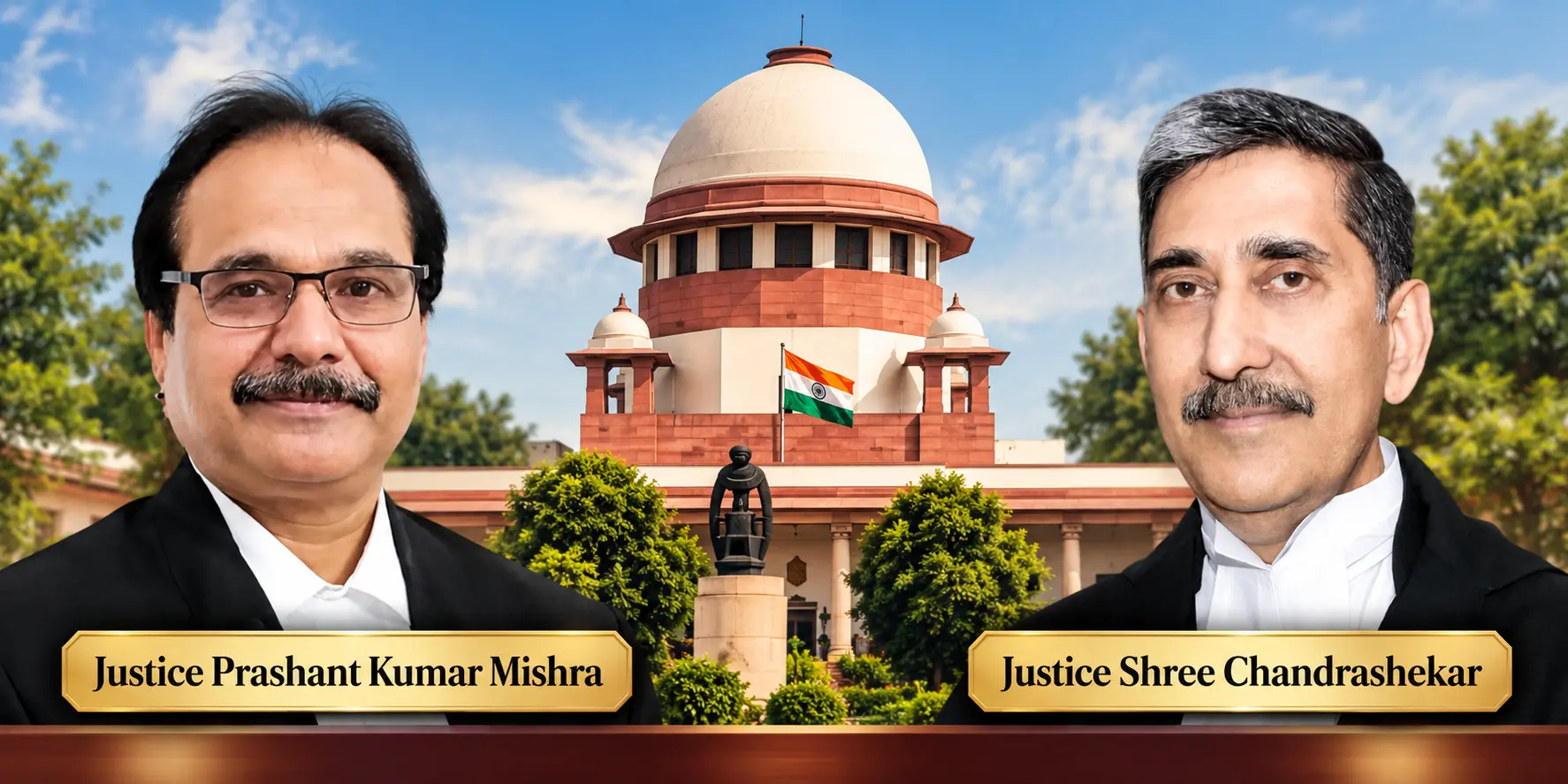
A Bench of Justice Shree Chandrashekhar and Justice Prashant Kumar Mishra allowed an appeal filed by the State of Maharashtra and the Anti-Terrorism Squad (ATS), Mumbai, and set aside the Bombay High Court judgment which had granted the accused the right to seek default bail.
The judgment was delivered in State of Maharashtra & Anr. v. Momin Moiuddin Gulam Hasan @ Moin Mistri & Anr., 2026 INSC 1021, arising out of SLP (Criminal) No. 12932 of 2024.
An FIR was registered by the ATS Police Station, Mumbai, on September 21, 2022, against several persons, including Momin Moiuddin Gulam Hasan @ Moin Mistri and Asif Aminul Hussain Khan Adhikari. The allegations included offences under Sections 120B, 121A and 153A of the IPC and Section 13(1)(b) of the UAPA.
The respondents were arrested on September 22, 2022 and remained in custody during the investigation. As the statutory period for completing the investigation approached, the prosecution sought an extension of time under Section 43-D of the UAPA read with Section 167 CrPC.
The Special Judge initially granted 30 days' additional time and subsequently granted another 15 days' extension for filing the charge sheet.
The accused challenged the extension and sought default bail. The Bombay High Court held that the second extension was illegal, observing that the investigation had already been completed and that the pendency of sanction for prosecution could not justify an extension for filing the charge sheet.
The Supreme Court disagreed with the High Court's approach.
The Court observed that investigation of a crime is the exclusive domain of the police and that it is not ordinarily for a court to decide when the investigation should stop.
The Court relied upon the established principle that the judiciary should not interfere with the statutory power of the police to investigate a cognizable offence, except in exceptional circumstances or where a statutory prohibition exists.
A significant factor before the Supreme Court was the prosecution's contention that further time was required to analyse data retrieved from mobile phones, computers and other electronic devices seized during the investigation.
The Court noted that the ATS was required to analyse the forensic data and establish its connection, if any, with the alleged activities. It also had to examine the flow of money through bank accounts and incorporate the relevant material into the charge sheet.
The Court held that analysis of the forensic and electronic material was itself part of the investigation and could not simply be postponed until after filing the charge sheet.
The Supreme Court further emphasized that filing a complete charge sheet is not merely a procedural formality.
The Court observed that the sanctioning authority must consider the material collected during investigation before deciding whether sanction for prosecution should be granted. Under Section 45(2) of the UAPA, the sanctioning authority is required to consider the report of the designated reviewing authority before granting sanction.
Therefore, the prosecution was required to complete the relevant investigation and place sufficient material before the sanctioning authority.
The Supreme Court reiterated that sanction under Section 45 of the UAPA is required at the stage of taking cognizance and not for filing the charge sheet.
However, the Court distinguished this legal position from the factual question of whether the investigation had actually been completed.
In the present case, the Court found that the investigation was not complete because the ATS was still required to analyse scientific and electronic evidence and prepare a complete report. Therefore, the High Court was incorrect in treating the investigation as complete merely because the prosecution had stated that sufficient evidence was available to file a charge sheet.
The Supreme Court concluded that the 15-day extension granted by the Special Judge on January 18, 2023 was legally valid.
Consequently, the Bombay High Court judgment dated July 15, 2024 was set aside and the accused's application for default bail was dismissed.
The Court directed Respondent No. 1 to surrender within 30 days, while permitting him to seek regular bail in accordance with law.
The Criminal Appeal filed by the State of Maharashtra and the ATS was accordingly allowed.
The judgment clarifies that while default bail is an important statutory and constitutional safeguard, an accused cannot claim it merely because a charge sheet was not filed within an initial period where the investigating agency has obtained a legally valid extension under the UAPA and the investigation genuinely remains incomplete.
At the same time, the Court reiterated that the requirement of a complete investigation and a legally justified extension of time cannot be bypassed merely by invoking the seriousness of the allegations.
Case Details:
Case: State of Maharashtra & Anr. v. Momin Moiuddin Gulam Hasan @ Moin Mistri & Anr.
Citation: 2026 INSC 1021
Bench: Justice Shree Chandrashekhar and Justice Prashant Kumar Mishra
Judgment Date: September 21, 2026

Representation:-
For Petitioner(s) : Mr. Bharat Bagla, Adv. Mr. Siddharth Dharmadhikari, Adv. Mr. Aaditya Aniruddha Pande, AOR Mr. Shrirang B. Varma, Adv.
For Respondent(s) : Mr. Shadan Farasat, Sr. Adv. Mr. Shaikh Saipan Dastgir, Adv. Mr. Rizwan Ahmad, AOR Mr. Shivam Yadav, Adv. Mr. Himanshu Gupta, Adv. Ms. Varisha Sharma, Adv.
Website designed, developed and maintained by webexy