
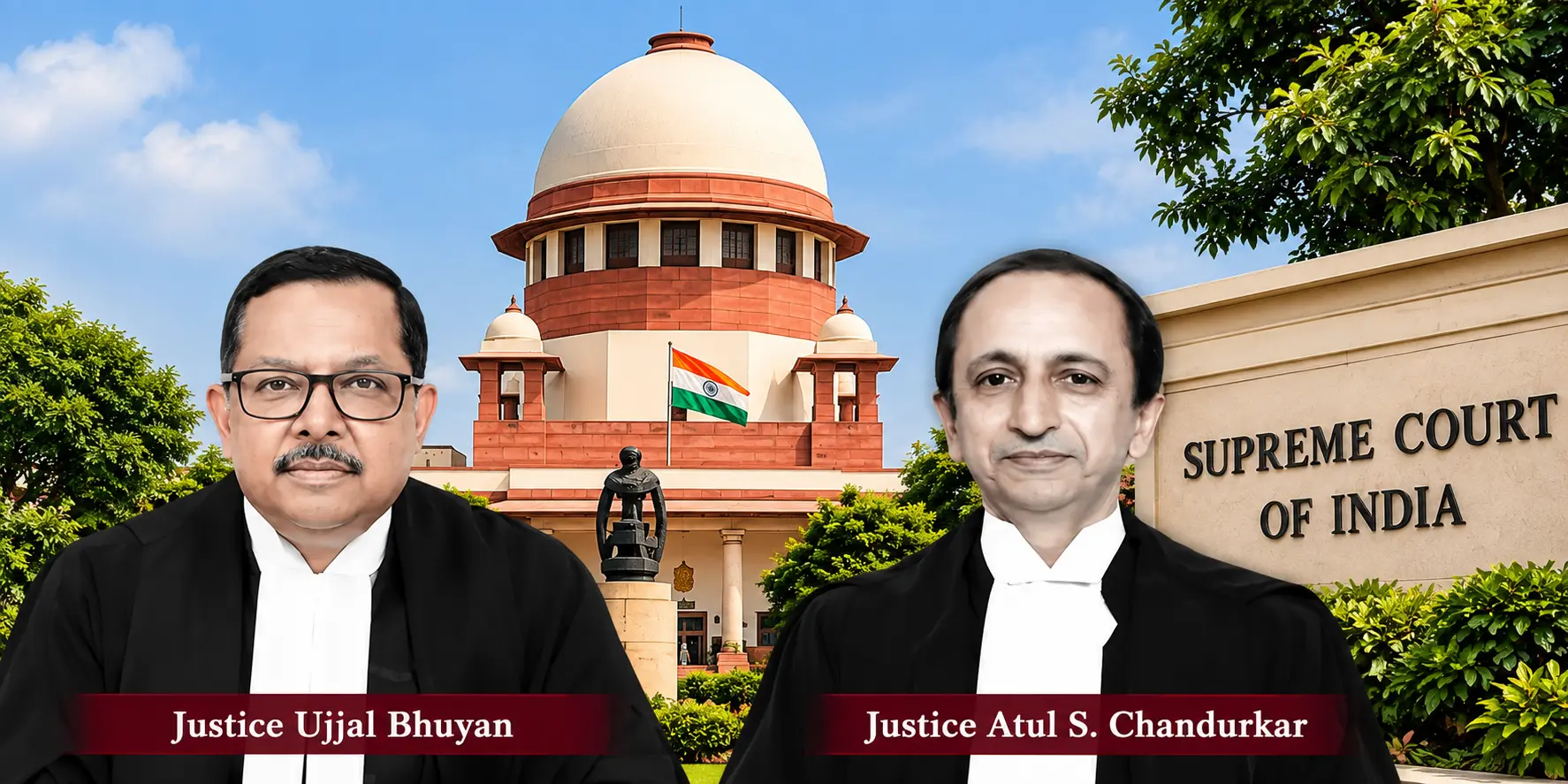
The Supreme Court has held that when an accused is released after violation of the constitutional safeguards under Article 22(1) or Article 22(2) of the Constitution, the investigating agency cannot simply re-arrest the person at its own discretion. Any subsequent arrest must follow a procedure involving judicial scrutiny and sanction.
A Bench comprising Justice Ujjwal Bhuyan and Justice Atul S. Chandurkar delivered the judgment in Jaskaran Jeet Singh Deol v. State of Punjab, 2026 INSC 1022, arising from Criminal Appeal No. 4234 of 2026.
The case concerned the arrest of Jaskaran Jeet Singh Deol in connection with an FIR registered under Sections 64, 65(1) and 351 of the Bharatiya Nyaya Sanhita, 2023, read with Section 6 of the POCSO Act. He was arrested on May 17, 2026, but was produced before the Magistrate only on May 18, beyond 24 hours. The Magistrate also found that written grounds of arrest had not been supplied to him.
The Supreme Court noted that the appellant had therefore suffered violations of both Article 22(1), which protects the right to be informed of the grounds of arrest, and Article 22(2), which requires production of an arrested person before the nearest Magistrate within 24 hours, subject to the constitutional exception relating to travel time.
Reiterating its earlier decision in Mihir Rajesh Shah v. State of Maharashtra, the Court held that the grounds of arrest must ordinarily be supplied in writing and in a language understood by the accused. Failure to comply with this constitutional requirement renders the arrest illegal and entitles the arrested person to immediate release.
The Court further clarified that where an arrest has been rendered illegal because the grounds of arrest were not supplied, the investigating agency cannot itself decide to re-arrest the accused.
Instead, it must first furnish the grounds of arrest and then move an application before the jurisdictional Magistrate explaining the reasons for the proposed re-arrest and the necessity for custodial interrogation. The application must also explain why the grounds of arrest were not supplied at the first instance.
Importantly, the Court directed that such an application must carry the endorsement of the immediate superior authority. The Court said this requirement would help rule out foul play or collusion and ensure that the superior officer is aware of the constitutional violation committed by the concerned police officer.
The Supreme Court made it clear that once Article 22(1) has been violated, the power to re-arrest cannot be left to the discretion of the same authority that committed the constitutional violation.
According to the Court, re-arrest must have judicial imprimatur. The Magistrate must be satisfied that there were bona fide reasons for the initial failure to furnish the grounds of arrest and that, after the grounds have subsequently been supplied, the accused actually needs to be re-arrested. Only then may the Magistrate permit the investigating agency to proceed with the re-arrest.
The Court also directed that, administratively, once such an application is made, the superior authority should hand over the investigation to another officer and initiate a departmental inquiry into the serious lapse.
On Article 22(2), the Supreme Court held that continued detention beyond 24 hours without production before the Magistrate is unconstitutional and renders the arrest illegal.
Referring to earlier judgments including Bhim Singh, Manoj and Subhash Sharma, the Court reiterated that violation of the 24-hour constitutional requirement affects the fundamental right to personal liberty under Article 21 as well.
The Court held that the same procedure applicable to a violation of Article 22(1) must also be followed where there has been a violation of Article 22(2), if the investigating agency still considers custody necessary after the accused's release.
Additionally, depending on the facts, the High Court may direct payment of compensation as a public law remedy for violation of Article 22(2), without preventing the accused from pursuing remedies available under private civil law.
The Supreme Court rejected the proposition that the seriousness of the allegations could justify ignoring constitutional safeguards.
It emphasized that constitutional violations cannot be treated differently depending upon the nature or gravity of the alleged offence. The Court reiterated that where the Constitution prescribes a procedure for depriving a person of personal liberty, that procedure must be rigorously followed.
The Court ultimately set aside and quashed the Punjab and Haryana High Court's order dated May 29, 2026, as well as the relevant observations of the Magistrate dated May 18, 2026.
It directed that if the respondents considered custodial interrogation necessary, they would have to follow the procedure laid down in Mihir Rajesh Shah and the directions contained in the present judgment. The Supreme Court clarified that it had not expressed any opinion on the merits of the allegations against the appellant.
The judgment has been directed to be circulated to the Director Generals of Police of all States and Union Territories, Registrars General of High Courts and Directors of State Judicial Academies.
Case Title: Jaskaran Jeet Singh Deol v. State of Punjab
Court: Supreme Court of India
Citation: 2026 INSC 1022
Case No.: Criminal Appeal No. 4234 of 2026

Representation:-
For Petitioner(s): Mr. Siddharth Aggarwal, Sr. Adv. Mr. Yoginder Handoo, AOR Mr. D. S. Sobti, Adv. Mr. Ashwin Kataria, Adv. Mr. Sultan Singh Sangha, Adv. Mr. Karan Dhalla, Adv. Ms. Khushboo Mittal, Adv. Mr. Garvit Solanki, Adv. Mr. Gaurav Vishwakarma, Adv. Mr. Aditya Aggarwal, Adv. Mr. Japman Singh, Adv. Mr. Akshat Patria, Adv.
For Respondent(s): Mr. Gopal Sankaranarayanan, Sr. Adv. Mr. Ajay Marwah, AOR Mr. Uday Jain, Adv. Mr. Rahil Mahajan, Adv. Mr. Aayushman Aggarwal, Adv. Mr. Indumugi C, Adv. Mr. Swaroopanand Mishra, Adv. Mr. Mrigank Bhardwaj, Adv. Mr. Rajkanwar Singh, Adv. Mr. Prabhjot Singh Waraich, Adv. Ms. Dhriti Sharma, Adv. Mr. Rahul Kumar, Adv. Mr. Ravideep Bdayal, Adv. Mr. Ravi Shandil, Adv. Mr. Rajat Bhardwaj, A.A.G. Mr. Siddhant Sharma, AOR Mr. Prafull Bhardvaj, Adv. Mr. Vikram Chaudhary, Adv. Mr. Dushyant Chaudhary, Adv. Mr. Snehil Himanshu, Adv.
Website designed, developed and maintained by webexy