
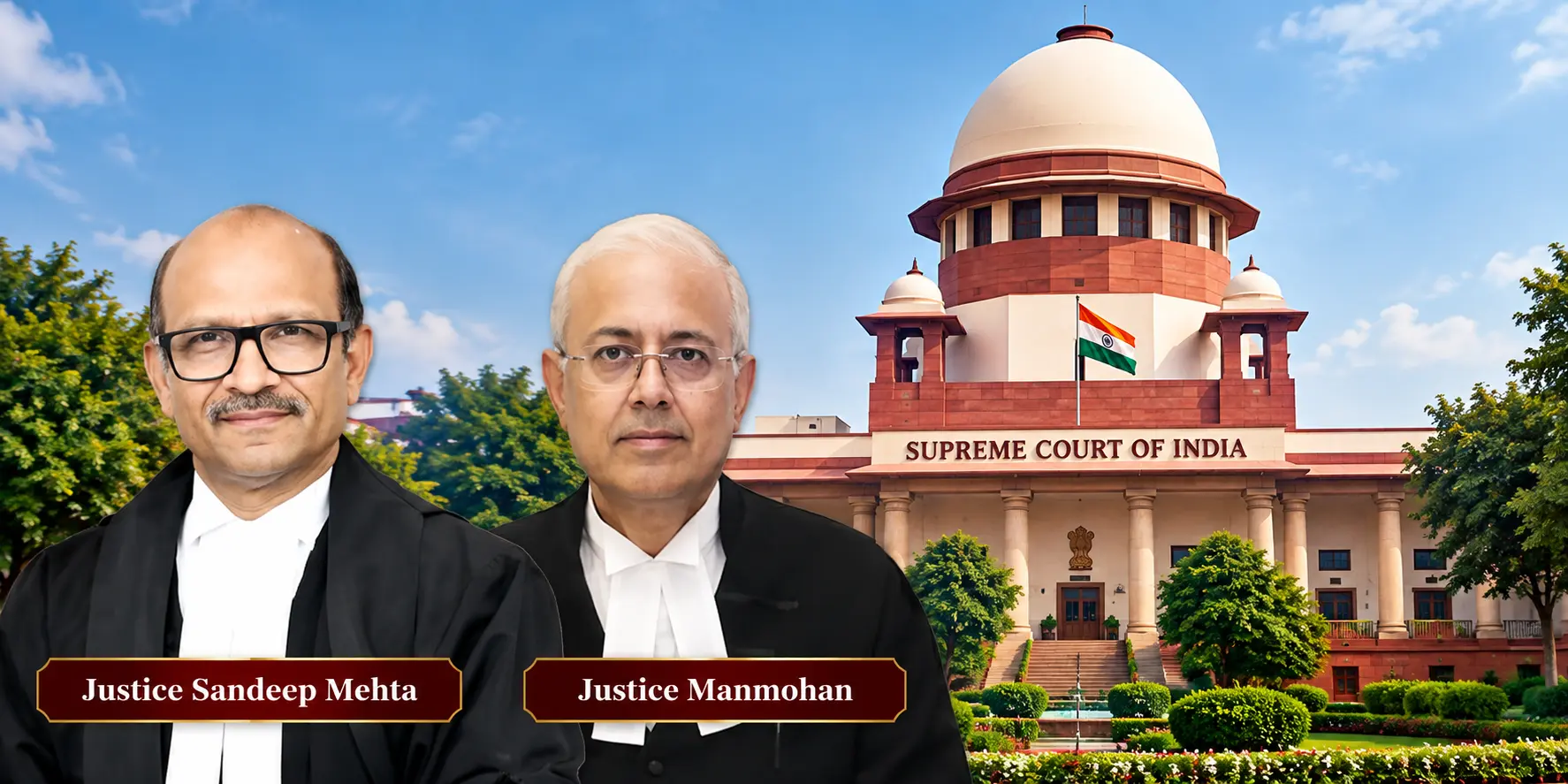
The Supreme Court has acquitted Abdul Rajik and Govind in an NDPS case, holding that the prosecution failed to establish an unbroken chain of custody of the samples allegedly drawn from the seized contraband.
A Bench comprising Justice Sandeep Mehta and Justice Manmohan allowed the appeals and set aside the conviction and sentence imposed by the Special Judge (NDPS), Jabalpur, and subsequently affirmed by the Madhya Pradesh High Court.
The appellants had been convicted under Section 8 read with Section 20(b) of the NDPS Act. Abdul Rajik was sentenced to 10 years' rigorous imprisonment and a fine of ₹1 lakh, while Govind was sentenced to 8 years' rigorous imprisonment and a fine of ₹80,000.
According to the prosecution, police received information on November 29, 2004, that two persons were carrying charas in bags near Bandariya Tiraha in Jabalpur. A police raiding team allegedly apprehended Abdul Rajik and Govind and recovered 1 kg of suspected charas from Abdul Rajik and 800 grams from Govind. Samples were drawn and sent to the Forensic Science Laboratory (FSL), Sagar, which reported that the samples were charas.
The two panch witnesses associated with the seizure proceedings, however, did not support the prosecution case and were declared hostile. The prosecution consequently relied substantially upon the testimony of police officials, particularly the seizure officer.
The Supreme Court closely examined the manner in which the samples were drawn, sealed, stored and transported to the FSL.
The Court found that the seizure officer did not state that the sample packets were properly sealed or that identifiable marks, signatures or thumb impressions were placed on the sample packets. The sample packets were also not separately produced or exhibited before the trial court.
The Court further noted that the sample panchnamas did not indicate that the packets were secured with the signatures or thumb impressions of the seizure officer, panch witnesses or accused, nor did they contain identification marks that could subsequently connect the samples to the seized contraband.
A crucial issue was the unexplained gap between the alleged dispatch and receipt of the samples.
The forwarding letter from the Superintendent of Police's office was dated December 1, 2004, whereas the FSL report recorded that the samples were received on December 6, 2004. The prosecution could not explain where the samples remained during those five days or in whose custody they were kept. The constable stated to have carried the samples was also not examined as a witness.
The Supreme Court held that the prosecution must establish through credible oral and documentary evidence that the samples remained properly sealed and safely secured from the time of seizure until their receipt by the FSL. Such link evidence is essential to establish the integrity and sanctity of the samples.
The Bench also found total non-compliance with Section 52-A of the NDPS Act, noting that the representative samples were not drawn in the presence of a Magistrate as contemplated by the provision.
The Court clarified that every procedural lapse under Section 52-A does not automatically result in an acquittal. However, total non-compliance becomes particularly significant when the prosecution is also unable to establish the safe custody and continuous chain of the samples.
Applying these principles, the Supreme Court concluded that the link evidence had completely broken down, destroying the sanctity and integrity of the samples.
As a result, the FSL report lost its evidentiary significance and had to be excluded from consideration. Without the FSL report, there was no other legally admissible evidence establishing that the substance allegedly recovered from the appellants was charas within the meaning of the NDPS Act.
The Court also rejected the seizure officer's claim that he could identify the substance as charas merely by burning a portion of it, observing that there was no scientific material establishing that such a test could determine the identity of charas.
The Supreme Court ultimately held that the prosecution had failed to prove that the recovered substance was charas. Giving the appellants the benefit of doubt, the Court set aside the judgments of conviction and sentence and acquitted Abdul Rajik and Govind.
The appellants, who were already on bail, were not required to surrender and their bail bonds were discharged. The appeals were accordingly allowed.
Case: Abdul Rajik v. State of M.P. with Govind v. State of M.P.
2026 INSC 1001
Criminal Appeal Nos. 1561 & 1562 of 2014
Judgment: September 16, 2026
Bench: Justice Sandeep Mehta and Justice Manmohan

Representation:-
For Appellant(s) : Mr. T. Mahipal, AOR Mr. Saurabh Ajay Gupta, AOR Mr. Ritik Gupta, Adv. Mr. Ayush Haritash, Adv.
For Respondent(s) : Ms. Mrinal Gopal Elker, AOR
Website designed, developed and maintained by webexy