
The Supreme Court has acquitted a man convicted under the Protection of Children from Sexual Offences (POCSO) Act, holding that statutory presumptions under Sections 29 and 30 of the POCSO Act do not relieve the prosecution of its obligation to establish the foundational facts and prove guilt beyond reasonable doubt.
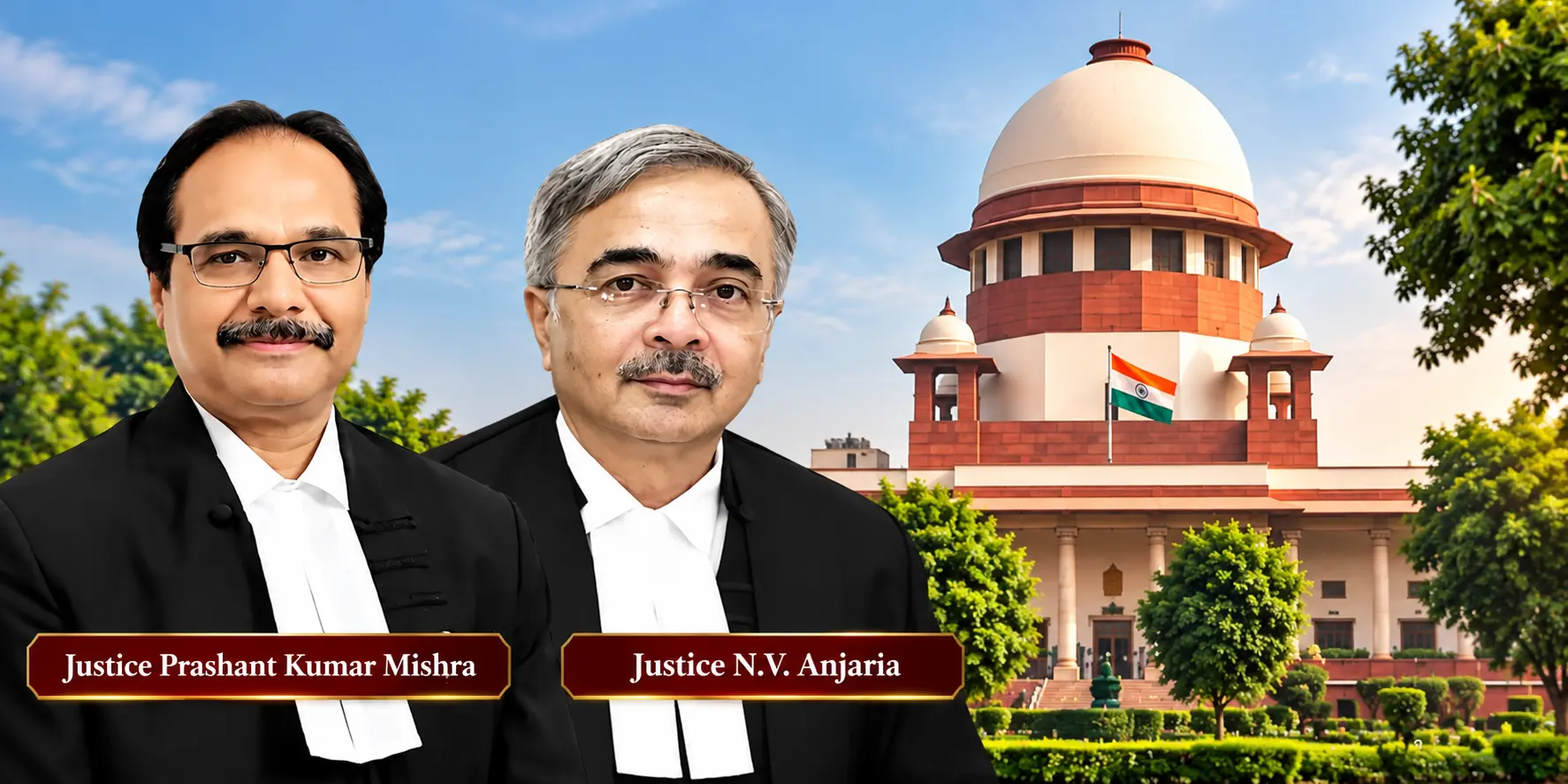
A Bench comprising Justice Prashant Kumar Mishra and Justice N.V. Anjaria allowed the criminal appeals filed by Deepak, setting aside the judgment of the Delhi High Court which had upheld his conviction and sentence under Section 363 of the IPC and Section 6 of the POCSO Act.
The trial court had sentenced the appellant to 10 years' rigorous imprisonment and a fine of ₹5,000 under Section 6 of the POCSO Act, along with one year's rigorous imprisonment and a fine of ₹3,000 under Section 363 IPC. The High Court had subsequently affirmed the conviction.
The Supreme Court undertook a detailed examination of the prosecution evidence and found significant inconsistencies between the testimony of the victim's mother and the evidence of the doctor who was stated to have first examined the child.
The Court noted that the mother stated that she had taken the child to the doctor at around 9:30 pm, whereas the doctor stated that the child had been brought to him at around 4–5 pm. The Court held that the discrepancy could not be treated as a minor inconsistency in the circumstances of the case.
The Court also considered the medical and forensic evidence. According to the judgment, the medical examination did not find injury or abnormality, while the FSL examination did not detect semen or male DNA on the relevant exhibits. The FSL expert also stated that blood could not be detected on the child's clothing.
A significant aspect of the judgment concerns Sections 29 and 30 of the POCSO Act, which provide statutory presumptions against an accused in specified circumstances.
The Supreme Court clarified that these provisions create rebuttable presumptions and cannot be interpreted to mean that the prosecution's version must automatically be accepted as true. Courts are still required to independently assess the evidence placed before them.
The Court observed that statutory presumptions do not absolve courts of their duty to scrutinise the evidence. The prosecution case cannot be treated as "gospel truth" merely because the POCSO Act contains provisions relating to presumptions of guilt.
The Court reiterated that the existence of a reverse burden under a statute does not alter the fundamental standard applicable to criminal prosecution.
It held that the prosecution remains required to establish the guilt of the accused beyond reasonable doubt. Where the statutory presumption operates, the accused may rebut it on the standard of preponderance of probability.
The Bench further emphasised that the reverse burden under Sections 29 and 30 of the POCSO Act cannot be allowed to undermine the accused's right to a fair trial under Article 21 of the Constitution.
The Supreme Court explained that once the accused successfully points out contradictions, inconsistencies, gaps, mismatches between ocular and medical evidence, or otherwise presents a reasonably probable defence, the statutory presumption may cease to have operative effect.
The Court stated that the ultimate determination must be based on the totality of the evidence, and that presumptive provisions cannot override evidence favouring the accused.
Applying these principles to the case, the Court found that the prosecution evidence contained material inconsistencies and contradictions and was not supported by the medical evidence. It concluded that the prosecution had failed to establish the appellant's guilt beyond reasonable doubt.
The Supreme Court accordingly set aside the Delhi High Court judgment dated July 3, 2025 and the trial court's conviction, holding the appellant not guilty of the offences under Section 363 IPC and Section 6 of the POCSO Act.
The Court directed that the appellant be released forthwith if he was in custody, unless required in connection with any other offence. The appeals were allowed.
Case: Deepak in JC v. State Govt. of NCT Delhi
2026 INSC 1008
Criminal Appeals arising out of SLP (Crl.) Nos. 21271-72 of 2025
Judgment dated: September 17, 2026
Bench: Justice Prashant Kumar Mishra and Justice N.V. Anjaria

Representation:-
For Petitioner(s) :Mr. Pulkit Prakash, AOR Mr. S.S. Sastry, Adv. Mr. Ankur Gosain, Adv. Ms. Arushi Sharma, Adv. Mr. Harsh Raj, Adv. Ms. Sriti Kashyap, Adv. Ms. Ankita Sinha, Adv. Mr. Gaurav Khanna, Adv.
For Respondent(s) :Mr. Davinder Pal Singh, A.S.G. Ms. Vidhi Gupta, Adv. Mr. Digvijay Singh, Adv. Ms. Karuna Sharma, Adv. Mr. Mukesh Kumar Maroria, AOR Mr. Rajan Kumar Chourasia, Adv. Mr. Bhuvan Kapoor, Adv. Ms. Seema Bengani, Adv. Mr. Udit Dediya, Adv. Mr. Mukul Singh, Adv. S.N. Terdal
Website designed, developed and maintained by webexy